
Common Causes of Thread Damage in CNC Tapping (and How to Prevent Them)

A tap that doesn’t break can still leave behind a hole that fails inspection — torn threads, an oversized bore that won’t hold a bolt, or a rough finish that a plug gauge rejects. In CNC production, this kind of thread damage is often more costly than an outright snapped tap, because the part usually isn’t scrap yet — it’s marginal, and marginal parts are the ones that slip through until a customer complaint or an assembly failure catches them.
This guide focuses specifically on what damages a thread’s quality — not just what breaks a tap — and what CNC tapping setups can do differently to prevent it.
Getting inconsistent thread quality on a CNC job? Tell our team the material, thread size, and tapholder setup, and we’ll help you troubleshoot it.
Thread Damage Is a Different Problem Than a Broken Tap
A broken tap stops production immediately and is impossible to miss. Thread damage is quieter: the tap survives the cycle, but the resulting thread doesn’t meet the tolerance class it was supposed to. The part might still thread a bolt in by hand and look fine to the eye, while still failing a proper inspection.
Metric internal and external threads are manufactured to defined tolerance classes under ISO 965 — the ISO standard for general-purpose metric screw thread tolerances, which sets the permitted limits on major diameter and pitch diameter for a given thread size and engagement length. Thread damage, in practical terms, is whatever pushes the cut thread outside those limits or leaves a surface finish that compromises fit and strength — even when the tap itself is still intact.
Common Causes of Thread Damage
Misalignment Between the Tap and the Hole
Keeping the tap coaxial with the hole is one of the central challenges in tapping, whether by hand or by machine. The first thread or two cut establishes the direction the rest of the threads will follow, and that direction can’t be corrected once cutting has started. With a thread depth beyond roughly two tap diameters, even a small angular error becomes pronounced — showing up as a thread that’s tight on one side and loose on the other, rather than a clean, uniform profile.
Chip Packing in Blind Holes
Clogging with chips is one of the classic causes of tapping problems generally, and in a blind hole specifically, trapped chips get pressed between the tap and the newly cut thread flanks, tearing or deforming the surface rather than cutting it cleanly. Whether this happens depends heavily on tap type: spiral point (“gun”) taps push chips forward, which works well in through-holes but has nowhere to go in a blind hole, while spiral flute taps pull chips back and out, making them the better-suited choice for blind-hole work.
Insufficient or Incorrect Cutting Lubricant
Improper or insufficient lubricant is a recognised cause of poor tapping results. Different materials need different lubricants — for example, a petroleum-based cutting oil with about 10% kerosene or mineral spirits added is suited to alloy and stainless steel, while cast iron is generally tapped dry with an air blast to clear chips rather than with oil. Using the wrong lubricant, or applying too little of it, increases friction and heat at the cutting edge, degrading the finish on the thread flanks.
A Worn or Damaged Tap
Tap wear isn’t always easy to quantify by eye, which is exactly why it’s a recurring, well-documented cause of poor tapping results — a tap that looks fine can already be cutting an out-of-tolerance thread. Non-standard or inferior-quality taps compound this risk further.
Wrong Tap Type for the Hole and Material
Using a tap with the wrong geometry for the application is a recognised cause of tapping problems in its own right. A bottoming tap’s very short chamfer (roughly 1 to 1.5 threads) is designed to finish threads at the bottom of a blind hole, not to start cutting into an unthreaded hole — using one to start a hole risks tearing the first few threads rather than cutting them cleanly.
Incorrect Tap Drill Size
The tap drill size — calculated for metric taps as major diameter minus pitch — determines how much thread engagement the tap actually has to cut. A hole drilled too small forces excessive engagement and torque, which can tear rather than cleanly form the thread crest; a hole drilled too large leaves an undersized, weak thread even if the cutting action itself looks clean.

Not sure which VÖLKEL tap fits your CNC setup? Send us the material, hole type, and thread size and we’ll recommend the right tap.
The CNC-Specific Cause: Feed and Spindle Synchronization
On a CNC machine, the tap’s advance (feed) must match the thread’s pitch exactly as the spindle rotates — every full turn of the spindle should move the tap forward by precisely one pitch length. Rigid tapping attachments, used specifically on CNC machines, are built to hold this relationship as tightly as possible throughout the cycle, including on reversal at the bottom of a blind hole.
This is also why good tapping holders combine several protective features rather than clamping the tap rigidly with nothing else: twin chucking (gripping both the tap’s circular and square sections for concentricity and positive drive), a safety clutch that disengages once a set torque limit is reached, radial float to absorb small misalignments, and length compensation to take up small push or pull differences during the cycle. Each of these exists specifically to absorb the small synchronization errors that feed/spindle mismatches or machine tolerances can introduce — errors that, left unaccounted for, translate directly into torn or oversized threads rather than a clean cut.
Forming Taps: A Different Way to Avoid Damage
A forming (fluteless, cold-forming, or roll) tap displaces metal into a thread shape instead of cutting it away, which means there are no chips generated at all — removing the chip-packing failure mode that damages so many threads in blind holes. Formed threads are typically stronger than cut threads, and form taps are also considerably stronger than cut taps of the same size, reducing breakage as well as damage risk.
The trade-off: forming taps only work in malleable materials such as mild steel or aluminium, and they need a larger, more accurate tap drill hole than a cutting tap of the same size — a slightly undersized hole can itself break the tap rather than simply damage the thread. Forming taps aren’t a universal fix, but in the right material, they remove one of the most common CNC thread-damage causes entirely.
A Quick Thread Damage Prevention Checklist
- Is the tap drill size correct for this tap, thread, and material? (Metric: major diameter − pitch)
- Is the tapholder mounted coaxially with the hole, ideally using a guide or a float/compensation holder rather than a rigid mount alone?
- Is the tap type (spiral point vs. spiral flute vs. forming) matched to whether the hole is through or blind?
- Is the correct lubricant for this material being applied consistently through the cut?
- Does the tapholder include twin chucking, a safety clutch, radial float, and length compensation?
- Is the tap being inspected for wear rather than assumed fine because it hasn’t broken?
- If using a forming tap, is the tap drill hole size and accuracy correct for the forming process?
- Are finished threads actually being checked against the relevant ISO 965 tolerance class, not just eyeballed?
Sourcing Threading Tools for CNC Tapping in Dubai
A supplier that stocks genuine, quality-made taps in the right geometry, along with the right holders and lubricants, makes it far easier to avoid the “inferior quality tap” and “wrong tap type” causes of thread damage before they ever reach the machine.
Khokhawala Trading LLC supplies threading solutions in Dubai and across the UAE, including VÖLKEL taps, dies, thread repair kits, and threading tools for precision CNC machining, maintenance, fabrication, and engineering applications.
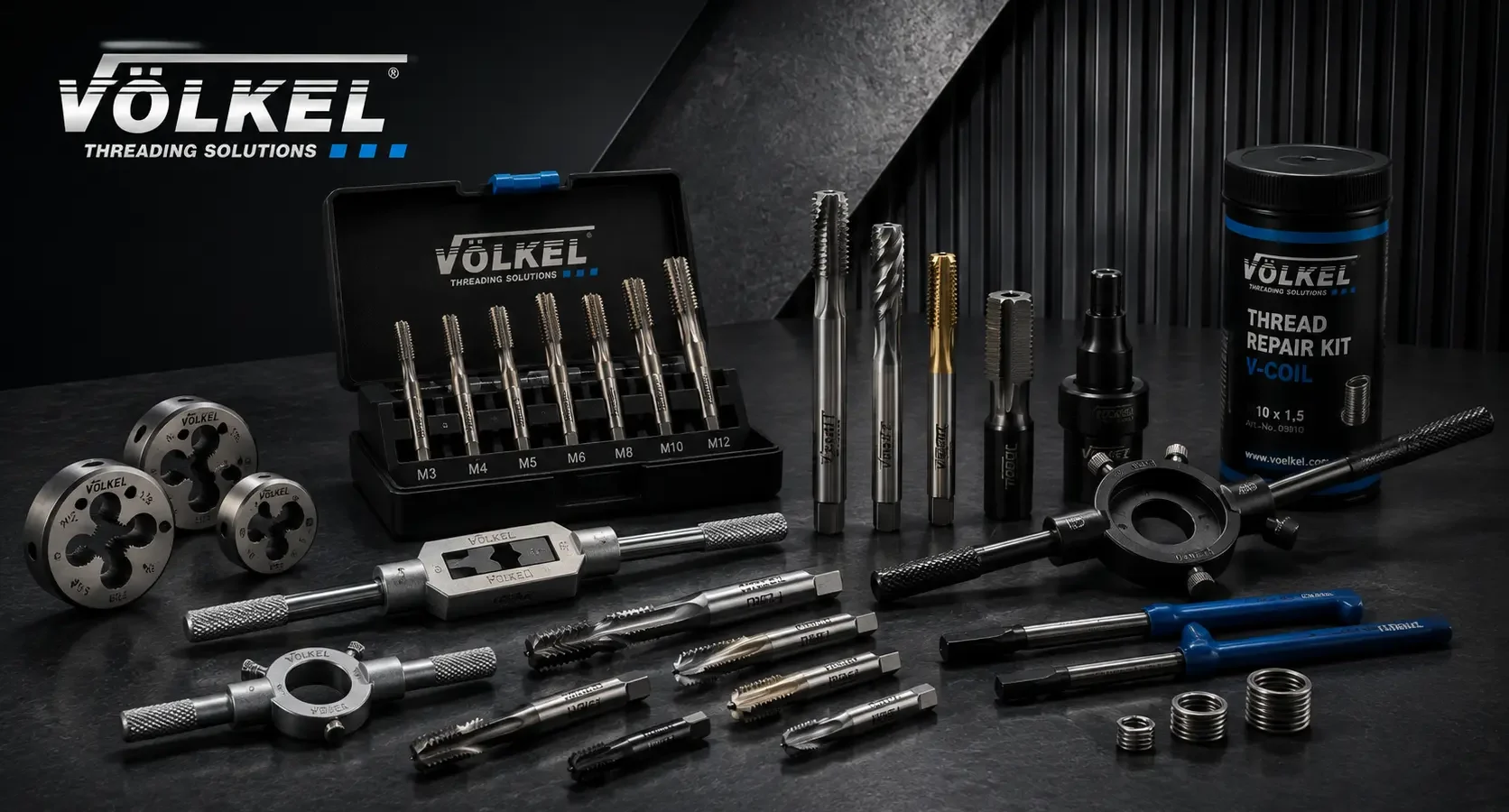
VÖLKEL is a German manufacturer with over 100 years of experience in tap manufacturing, offering more than 12,000 threading tools across nearly all international thread standards, including hand taps, machine taps, round dies, and forming taps, plus the V-COIL thread repair system for restoring damaged threads. With more than 35 years of industrial tool supply experience, Khokhawala Trading LLC serves manufacturers, CNC shops, fabrication companies, and engineering industries in the UAE.
Ready to shop threading solutions? Browse our VÖLKEL tap and thread repair range or reach out with your requirement for a fast quote.
Conclusion
Thread damage in CNC tapping usually comes down to a small set of causes: misalignment, chip packing in blind holes, wrong or insufficient lubricant, tap wear that isn’t visible yet, the wrong tap type for the hole, an incorrect tap drill size, or feed/spindle synchronization errors the tapholder wasn’t built to absorb. None of these require a new machine to fix — they require checking the setup against each of these causes, one at a time, rather than assuming a tap that hasn’t broken is automatically cutting a good thread.
For businesses sourcing threading tools in Dubai, Khokhawala Trading LLC supplies VÖLKEL taps, dies, and thread repair systems for precision CNC machining, fabrication, and engineering applications.
Chasing Inconsistent Thread Quality?
Send us your material, thread size, hole type, and tapholder setup, and Khokhawala Trading LLC will help you find the right tap and technique.
Thread Damage in CNC Tapping, Answered
A broken tap stops the job immediately and is obvious. Thread damage is quieter — the tap survives, but the resulting thread falls outside its intended tolerance class or has a degraded finish, which can go unnoticed without proper inspection.
The recurring causes are chip packing (especially in blind holes), insufficient or incorrect lubricant, a worn or damaged tap, and the wrong tap geometry for the hole and material.
The first thread or two cut sets the direction for the rest of the thread, and that can’t be corrected afterward. Beyond about two tap diameters of depth, a small angular error becomes pronounced, producing a thread that’s uneven around its circumference rather than uniform.
Rigid tapping is a CNC method where the machine synchronizes the tap’s feed rate with spindle rotation to match the thread pitch precisely. Rigid tapping attachments are used specifically on CNC machines to hold this relationship, and errors in that synchronization are a CNC-specific cause of thread damage.
Good tapping holders combine twin chucking for concentricity, a safety clutch that disengages at a set torque, radial float to absorb small misalignments, and length compensation to take up push/pull differences during the cycle — each addresses a specific way small synchronization or alignment errors would otherwise damage the thread.
In suitable materials, yes. Forming taps displace metal rather than cutting it, producing no chips and removing the chip-packing failure mode entirely, and formed threads are typically stronger than cut threads. They only work in malleable materials like mild steel or aluminium, and need an accurate, slightly larger tap drill hole.
Check it against the standard metric formula: tap drill size equals major diameter minus pitch. A hole drilled too small forces excessive engagement and torque, which can tear the thread; a hole drilled too large leaves an undersized, weak thread.
Spiral flute taps, which pull chips back and out of the hole, are generally preferred for blind holes over spiral point (“gun”) taps, which push chips forward — with nowhere to go in a hole that doesn’t pass through the material.
Metric threads are manufactured to tolerance classes defined by ISO 965, the ISO standard for general-purpose metric screw thread tolerances, which sets permitted limits on major diameter and pitch diameter for a given thread size and engagement length.
Khokhawala Trading LLC supplies threading solutions in Dubai and across the UAE, including VÖLKEL taps, dies, and thread repair kits, for precision CNC machining, maintenance, fabrication, and engineering applications.