
Why Is My Tap Breaking? Common Threading Mistakes and How to Fix Them

A snapped tap is one of the most frustrating failures in any workshop — it doesn’t just waste the tap itself, it can ruin an otherwise finished part and cost far more time in extraction than the tapping operation ever should have taken.
The good news is that tap breakage is rarely random. It almost always traces back to a small number of recurring causes: the wrong tap for the job, the wrong drill size, poor chip evacuation, misalignment, insufficient lubrication, or simple operator technique.
This guide walks through why taps actually break, the threading mistakes that cause it most often, and what to check before you reach for another tap.
Taps keep snapping on a specific job? Tell our team the material, thread size, and hole type, and we’ll help you find the right tap and technique.
What Is a Tap, and How Does It Cut a Thread?
A tap is used to cut or form the female portion of a threaded pair — for example, the internal thread inside a nut or a tapped hole. The matching tool for cutting the external, male thread on a rod or bolt is called a die; the process of tapping cuts internal threads, while the process using a die is called threading.
Tapping begins with drilling (and lightly countersinking) a hole to a diameter smaller than the tap’s major diameter. The correct diameter is called the tap drill size, and it can be calculated directly: for metric taps, tap drill size = major diameter − pitch, which for a standard M10 × 1.5 tap gives a drill size of 8.5 mm. This formula produces an approximate 75% thread.
Whether the job is done by hand or by machine, the operator (or program) then turns the tap into the hole, cutting the thread as it advances. With hand tapping, the machinist must periodically reverse the tap to break the chip and prevent it from crowding and breaking the tap.
The Main Types of Taps (and Why the Choice Matters)
Using the wrong tap for the job is one of the most common — and most avoidable — causes of breakage. The three basic hand tap types are:
- Taper tap — has a very gradual cutting action, with 8 to 10 tapered threads at the tip. It’s most often used when the material is difficult to work (such as alloy steel) or when the tap itself is a very small diameter and therefore prone to breakage.
- Intermediate (plug or second) tap — the most commonly used type, with 3 to 5 tapered threads that help align and start the tap into an untapped hole.
- Bottoming tap — has almost no taper (typically 1 to 1.5 threads), allowing it to cut threads to the bottom of a blind hole. Because its chamfer is too short to start into an unthreaded hole, it’s normally used only after a taper or plug tap has already started the thread.
For soft or average-hardness materials such as plastic, aluminium, or mild steel, a plug tap alone is often enough. For a blind hole, the machinist uses a plug tap until the tap’s point reaches bottom, then switches to a bottoming tap to finish. With hard materials, it’s common to start with a taper tap — its gentler diameter transition reduces the torque needed to cut — followed by a plug tap and, if needed, a bottoming tap.
Power-driven taps are built differently again. The most common type is the spiral point plug tap, or “gun” tap, whose cutting edges are angularly displaced so the tap continuously breaks the chip and ejects it forward — well suited to through-holes. Spiral flute taps, whose flutes resemble a twist drill’s, are widely used in high-speed automatic tapping because they clear chips well even in blind holes.
A forming (fluteless, cold-forming, or roll) tap works differently again: instead of cutting metal away, it displaces the metal into a thread shape as it’s turned in. Because there are no chips to evacuate, forming taps largely remove the jamming risk that causes many cutting-tap breakages — particularly in blind holes — and formed threads are typically stronger than cut threads. Form taps are also considerably stronger than cut taps of the same size, which significantly reduces breakage; however, forming taps only work in malleable materials such as mild steel or aluminium, need a larger, more accurate tap drill hole than a cutting tap of the same size, and a slightly undersized hole can itself break the tap.

Not sure which tap type fits your material? Send us the material, hole type, and thread size and we’ll recommend the right VÖLKEL tap.
The Common Reasons Taps Break
Although machine tapping is generally more accurate than hand tapping, tapping operations have traditionally been tricky to execute reliably because of frequent tap breakage. The commonly cited causes fall into a fairly short, well-known list:
- Use of a worn-out tap, where the wear isn’t always easy to quantify by eye
- Use of a tap with the wrong geometry for the application
- Use of non-standard or inferior-quality taps
- Clogging with chips (swarf)
- Misalignment between the tap and the hole
- Over- or under-feeding the tap, causing breakage in tension or compression
- Use of improper or insufficient cutting lubricant
- Absence of a torque-limiting feature on the tapping holder
- Improper spindle speed
Notice how few of these are actually about the tap being “weak.” Most come down to setup, alignment, lubrication, and matching the tap to the job — all things that are fixable without buying a more expensive tap.
Misalignment: The Silent Tap Killer
The biggest challenge in simple hand tapping is keeping the tap coaxial with the hole — going in straight rather than on an angle. The operator has to get this close to perfect to cut good threads and avoid breaking the tap.
The deeper the thread, the more the error matters. With a thread depth of only 1 or 2 tap diameters, small angular errors matter little; beyond about 2 diameters, the error becomes too pronounced to ignore.
Alignment errors compound because the first thread or two cut establishes the direction the rest of the threads will follow — you cannot correct the angle once those first threads are cut. Even a skilled operator working freehand, without a guide, can easily introduce a 2° to 5° error.
To reduce this risk, several types of jigs and fixtures are commonly used:
- Hand-tapper — a fixture shaped like a small arbor press, holding the tap’s spindle accurately perpendicular to the work so the operator doesn’t have to judge perpendicularity freehand.
- Tapping guide — a simple conical guide slipped over the tap when using a regular tap wrench, again providing the correct geometry mechanically.
- Tapping attachments and quick-change drilling/tapping chucks — available for both manual and CNC machines.
- Rigid tapping attachments — used specifically on CNC machines.
Good tapping holders generally combine several features: twin chucking (gripping both the tap’s circular and square sections, for concentricity and positive drive), a safety clutch that disengages once a set torque limit is reached, radial float to absorb small misalignments, and length compensation to take up small push or pull differences during the cycle.
Lubrication: Matching the Fluid to the Material
Insufficient or incorrect cutting lubricant is one of the most common — and easiest to fix — causes of tap breakage. Recommended lubricants vary by material:
| Material | Recommended Lubricant |
|---|---|
| Carbon (mild) steel | Petroleum-based or synthetic cutting oil |
| Alloy steel | Petroleum-based cutting oil with about 10% kerosene or mineral spirits added |
| Stainless steel | Same alloy-steel mixture (petroleum-based oil with ~10% kerosene/mineral spirits) |
| Cast iron | No lubricant — use a low-velocity air blast to clear chips instead |
| Aluminium | Kerosene or mineral spirits with 15-25% petroleum-based cutting oil added |
| Brass | Kerosene or mineral spirits |
| Bronze | Kerosene or mineral spirits with about 10-15% petroleum-based cutting oil added |
Note that cast iron is the exception — it’s generally tapped dry, since its own graphite content provides some natural lubricity and added oil can trap abrasive particles against the cutting edges. Every other common material benefits from an appropriate cutting fluid, applied consistently through the cut, not just at the start.
Chip Packing and Blind Holes
Clogging with chips is one of the classic mechanical causes of tap breakage, and it’s largely a function of tap type versus hole type. Spiral point (“gun”) taps push chips forward, ahead of the tap, which works well in through-holes where the chips have somewhere to go. In a blind hole, those chips have nowhere to go and can jam and snap the tap.
Spiral flute taps, by contrast, pull chips back up and out of the hole along the flutes, which is why they’re the preferred choice for blind-hole tapping, particularly in high-speed automatic operations.
With straight-flute hand taps, the operator must periodically reverse the tap to break the chip and prevent crowding — skipping this step, or backing off too little, is a very common way to jam and snap a tap partway down a blind hole.
Removing accumulated chips is particularly important in blind holes, which is part of why forming (fluteless) taps — which produce no chips at all — are especially well suited to blind-hole applications in suitable materials.
If a Tap Does Break: Removal Options
Tap breakage is common, and removal is often difficult once it happens. Depending on the size of the tap, the material, and how deep it broke, several removal methods are used in practice:
- Manually smashing the tap to loosen the fragments
- Using a dedicated tap extractor
- Milling the broken tap out
- Grinding it out, for example with an Omegadrill-style tool
- TIG welding a rod to the broken fragment to back it out
- Electrical discharge machining (EDM), for the most stubborn or deeply broken cases
All of these take considerably longer than the tapping operation itself would have — which is exactly why identifying and fixing the root cause matters more than simply reaching for a replacement tap.
A Quick Checklist Before You Tap Again
If a tap has just broken, run through these points before starting the next hole:
- Is the tap drill size correct for this tap and material? (Metric: major diameter − pitch)
- Is this the right tap type — taper, plug, or bottoming — for a starting hole vs. a blind-hole finish?
- Is the tap aligned coaxially with the hole, ideally using a guide or holder rather than freehand?
- Is the correct lubricant for this material being applied consistently through the cut?
- Is the tap being reversed periodically to break the chip, especially in a blind hole?
- Is the tapping holder fitted with a safety clutch or torque-limiting feature?
- Is the tap worn, chipped, or visibly damaged from a previous job?
- Is the spindle speed appropriate for a hand tap being driven under power?
Working through this list systematically, rather than just swapping in a new tap of the same type, is usually what actually stops the breakage from recurring.
Choosing a Threading Tools Supplier in Dubai
A supplier that stocks genuine, quality-made taps in the right geometry and material grade makes it far easier to avoid the “inferior quality tap” cause of breakage in the first place.
Khokhawala Trading LLC supplies threading solutions in Dubai and across the UAE, including VÖLKEL taps, dies, thread repair kits, and threading tools for precision machining, maintenance, fabrication, and engineering applications.
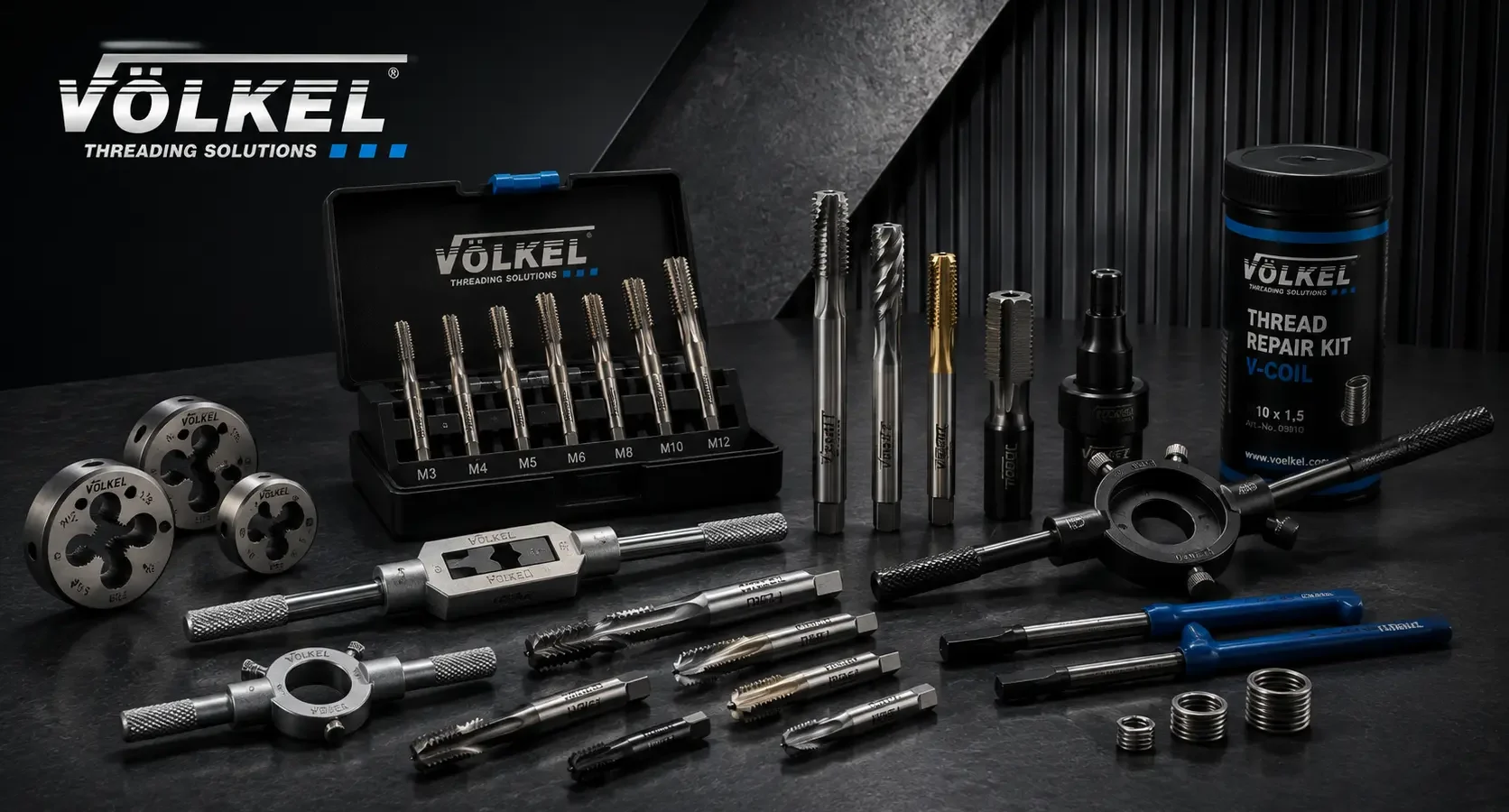
VÖLKEL is a German manufacturer with over 100 years of experience in tap manufacturing, offering more than 12,000 threading tools across nearly all international thread standards, including hand taps, machine taps, round dies, and forming taps, plus the V-COIL thread repair system for restoring damaged threads. With more than 35 years of industrial tool supply experience, Khokhawala Trading LLC serves manufacturers, CNC shops, fabrication companies, and engineering industries in the UAE.
Ready to shop threading solutions? Browse our VÖLKEL tap and thread repair range or reach out with your requirement for a fast quote.
Conclusion
Tap breakage is almost never bad luck — it’s the result of a small, well-documented set of causes: the wrong tap for the material or hole, an incorrect tap drill size, chip packing, misalignment, insufficient lubrication, or missing torque protection on the holder.
Working through these one at a time, rather than simply swapping in another tap, is what actually stops the problem from repeating on the next job.
For businesses sourcing threading tools in Dubai, Khokhawala Trading LLC supplies VÖLKEL taps, dies, and thread repair systems for precision machining, fabrication, and engineering applications.
Still Losing Taps on the Same Job?
Send us your material, thread size, hole type, and machine setup, and Khokhawala Trading LLC will help you find the right tap and technique.
Tap Breakage, Answered
The most common causes are a worn or unsuitable tap, chip clogging, misalignment between the tap and hole, over- or under-feeding, insufficient cutting lubricant, no torque-limiting feature on the holder, and incorrect spindle speed.
For metric taps, tap drill size equals the major diameter minus the thread pitch. For an M10 x 1.5 tap, that’s 10 – 1.5 = 8.5 mm. This produces an approximate 75% thread.
A taper tap has a very gradual cutting action (8-10 tapered threads) suited to hard materials or small diameters. A plug tap has 3-5 tapered threads and is the most commonly used general-purpose type. A bottoming tap has almost no taper and finishes threads to the bottom of a blind hole, but can’t start an unthreaded hole on its own.
In a blind hole, chips have nowhere to escape, so they can pack around the tap and jam it. Spiral flute taps, which pull chips back and out of the hole, are generally preferred for blind holes over spiral point taps, which push chips forward.
Yes. Even a skilled operator working freehand can introduce a 2-5 degree misalignment, and the first thread or two cut sets the direction for the rest — it can’t be corrected afterward. The error matters most once the thread depth exceeds about 2 tap diameters.
A petroleum-based cutting oil mixed with about 10% kerosene or mineral spirits is a suitable lubricant for stainless steel, the same mixture recommended for alloy steel.
No lubricant is generally needed for cast iron — a low-velocity air blast to clear chips is the recommended approach instead.
A forming tap displaces metal into a thread shape instead of cutting it away, so it produces no chips to jam the tap. Form taps are also considerably stronger than cut taps of the same size, which significantly reduces breakage — but they only work in malleable materials like mild steel or aluminium and need an accurate, slightly larger tap drill hole.
Common methods include manually smashing the tap loose, using a dedicated tap extractor, milling or grinding it out, TIG welding a rod to the fragment to back it out, and, for the most stubborn cases, electrical discharge machining (EDM).
Khokhawala Trading LLC supplies threading solutions in Dubai and across the UAE, including VÖLKEL taps, dies, and thread repair kits for precision machining, maintenance, fabrication, and engineering applications.