

A caliper is one of the most widely used general-purpose measuring tools in any workshop, used to measure the length, width, thickness, diameter, or depth of a part.
Both vernier and digital calipers measure inside, outside, depth, and step dimensions in essentially the same way, using a fixed jaw and a sliding jaw that closes on the workpiece.
The real difference is in how the measurement is read, how quickly it can be read, and how the tool behaves in day-to-day workshop conditions.
This guide explains how each type works, what the manufacturers’ own accuracy and resolution figures actually mean, and how to decide which caliper suits your workshop, your operators, and your budget.
Not sure which caliper suits your application? Tell our team what you’re measuring and how the tool will be used, and we’ll help you pick the right caliper.
What Is a Caliper?
The word caliper comes from a corrupted form of “caliber,” and calipers are used to measure the linear dimensions of an object or a hole — namely length, width, thickness, diameter, or depth.
Because of their diverse measuring modes, ease of operation, wide measuring range, and relatively low cost, a caliper is often considered one of the best general-purpose tools to have in a toolkit.
Calipers are used across a very wide range of fields. Users include dentists, scientists, archaeologists, mechanics, machinists, chemists, and anthropologists — essentially anyone who needs to take a linear measurement.
Many types of calipers allow a reading to be taken from a ruled scale, a dial, or an electronic digital display. The sliding vernier scale is a common and historic design still widely used today.
Because calipers see such varied and sometimes harsh use, most caliper jaws are heat-treated and hardened to 62 HRC or better. Almost all modern calipers are made of flame-hardened stainless steel, which is sufficient for normal workshop use.
When measuring very hard or abrasive workpieces, such as grinding wheels or cemented carbide cutting tools, ordinary caliper jaws can still wear. Tungsten-carbide inserts in the jaws are used to extend caliper life in these conditions.
Digital vs Vernier Caliper: At a Glance
Both instrument types share the same jaws, the same beam, and the same basic measuring principle. The difference lies entirely in how the position of the slider is read and displayed.
| Factor | Vernier Caliper | Digital Caliper |
|---|---|---|
| Readout | Ruled main scale + sliding vernier scale | Electronic LCD display |
| Reading method | Manual interpolation of two scales | Direct numeric reading |
| Mechanical magnification | None — needs good eyesight or a magnifying glass | Not applicable; digits are read directly |
| Typical resolution | 0.02 mm on a typical metric scale; .001 in on a typical inch scale | Commonly 0.01 mm / .0005 in on standard 150–200 mm models |
| Zero setting | Reads any point in its range without needing to reset zero | Conventional types must be zeroed at power-on; ABSOLUTE types do not |
| Inch/mm switching | Cannot convert seamlessly between inch and metric | Many models switch between inch and mm at the press of a button |
| Power source | None — fully mechanical | Battery-powered (commonly an SR44 button cell) |
| Environmental protection | Not affected by battery or electronics failure | Some models are rated IP66/IP67 for dust and coolant resistance |
| Parallax error risk | Present, since scales sit on slightly different levels | Not applicable to the digital readout itself |
How to Read a Vernier Caliper
The vernier scale is a device that allows an evenly divided straight or circular measurement scale to be read to a far greater resolution than its smallest divisions would otherwise allow.
It works by dividing the main scale using an auxiliary sliding scale — the vernier scale — that moves against the main scale. The first caliper to use this secondary scale was invented in 1631 by the French mathematician Pierre Vernier.
On a typical metric vernier caliper, each division on the vernier scale is 0.02 mm shorter than one main-scale division of 1 mm. As the jaws open, each 0.02 mm of movement brings a new vernier line into coincidence with a main-scale line, indicating the fraction of the main-scale division to be counted.
On an inch vernier, the main scale has .025 in divisions, and the vernier scale divisions are .001 in shorter than two main-scale divisions — giving a resolution of .001 in while keeping the graduations easier to space out and read.
Reading a vernier caliper, especially a metric one, is fairly straightforward, but it does require good eyesight or a magnifying glass, since there is no mechanical magnification. Parallax error is also a factor to guard against, as the two scales sit on slightly different levels.

How to Read a Digital Caliper
Conventional digital calipers use a basic binary system: a series of light and dark bands sit under the slider, and the caliper counts these bands as they pass while it moves along the track.
Because the system has no way of knowing the slider’s absolute position from the pattern alone, it depends on counting bands from a known starting point. This is why, with most conventional digital calipers, the jaws must be closed and the display zeroed immediately after switching on, before the first measurement.
This changed with the introduction of Mitutoyo’s ABSOLUTE digital caliper technology, which can read the slider’s location at any position and at any time — even after the caliper has been powered off — without needing to reset zero.
The ABSOLUTE digital caliper takes advantage of both analogue and digital principles. It uses sensors within the slider together with corresponding precision tracks embedded in the main beam; as the slider moves, it reads the tracks under the sensors and calculates its own absolute position.
Many digital calipers also include a Zero/ABS key that lets the display be zero-set at any slider position for incremental comparison measurements, plus an inch/metric conversion button — features a purely mechanical vernier caliper cannot offer.

Need a caliper with IP-rated protection for a wet or dusty shop floor? Send us your working environment and we’ll recommend a suitable Insize or Mitutoyo model.
Accuracy, Resolution, and Repeatability
Resolution and accuracy are not the same thing. Resolution is the smallest increment the tool can display or read; accuracy is how close that reading is to the true dimension.
The measurement accuracy of a caliper, sometimes called instrumental error, is generally expressed in steps. Over a 0-200 mm (0-8 in) range, a typical caliper carries a measurement uncertainty of around ±0.02 mm (±.0008 in) when zeroed with the jaws closed, increasing by roughly ±0.01 mm (±.0004 in) for each additional 200 mm of range, up to about 1000 mm.
This is consistent with common standard digital calipers in the 150-200 mm range, which are typically specified with a resolution of 0.01 mm (.0005 in) and an accuracy of around ±0.02 mm (±.001 in).
Because a caliper is not compliant with Abbe’s Principle — the axis of measurement is not coaxial with the measuring scale axis — care is needed in how it is used if accuracy is to be maximized.
Measuring technique matters as much as the instrument itself. The recommended approach is to open and close the jaws a few times, confirming the display reads zero each time (not required on ABSOLUTE-type digital calipers, though it’s still good practice to check). Take more than one reading, since the first reading tends to be less reliable, and continue measuring until the value starts to repeat.
Measuring force also matters: touch the workpiece and back off, then touch again and back off, applying light and consistent pressure. Personal bias between different operators can amount to as much as 50 μm (.002 in), though with practice this bias can be reduced toward zero.
Choosing Between Digital and Vernier for Your Workshop
Once you understand how each caliper is read, the choice comes down to how the tool will actually be used day to day.
1. Reading Speed and Operator Experience
A digital caliper gives a direct numeric readout, which removes the need to interpolate two scales and reduces the chance of a misread value — useful where operators rotate frequently or are less experienced with vernier reading.
A vernier caliper takes more practice to read quickly and accurately, particularly on the inch scale, but the reading skill, once learned, does not depend on a working display or battery.
2. Workshop Environment
Coolant, cutting fluid, and metal dust are common on a shop floor. Some digital calipers are built and rated (for example IP66 or IP67) for resistance to dust and low- or high-pressure liquid jets, or short-term immersion.
A vernier caliper has no electronics to protect and is not affected by a dead battery, though its sliding scale still needs to be kept clean for smooth, accurate movement.
3. Budget and Long-Term Cost
A vernier caliper has no battery to replace and no display to fail, which can make it a reliable, low-maintenance choice for a spare or backup tool.
A digital caliper adds the ongoing (if infrequent) cost of battery replacement, but the ABSOLUTE-type models remove the daily hassle of re-zeroing at every power-on.
4. Working in Both Inch and Metric
If your work regularly switches between inch and metric drawings, this is one of the clearest practical differences: a vernier caliper cannot convert seamlessly between the two, while many digital calipers switch units at the press of a button.
5. Data Output and Traceability
Where measurements need to be logged for SPC (statistical process control) or quality records, digital calipers with SPC data output are available, letting readings be captured directly rather than transcribed by hand. A vernier caliper has no such output and depends on manual recording.
Vernier or Digital: A Quick Decision Guide
| If you need… | Consider |
|---|---|
| A rugged, battery-free tool as a backup or spare | Vernier caliper |
| Fast, unambiguous readings for less experienced operators | Digital caliper |
| Frequent switching between inch and metric drawings | Digital caliper |
| Use in a wet, coolant-heavy, or dusty environment | IP-rated digital caliper |
| Incremental (INC) comparison measurements without resetting zero | ABSOLUTE-type digital caliper |
| Logged readings for SPC or quality records | Digital caliper with SPC output |
| The lowest long-term running cost, no battery dependency | Vernier caliper |
Common Mistakes When Choosing or Using a Caliper
Assuming Digital Is Always More Accurate
A digital readout is easier to read, but resolution and accuracy still depend on the specific model and its manufacturing tolerance. A well-made vernier caliper, used correctly, can be just as accurate as a comparable digital model of similar range.
Skipping the Zero Check
Even on ABSOLUTE-type digital calipers that don’t strictly require re-zeroing at power-on, it remains good practice to close the jaws and confirm the display reads zero before taking a measurement.
Ignoring Measuring Force and Technique
Applying inconsistent force, or failing to align the jaws squarely with the workpiece, is a common source of measurement error on both caliper types — not a fault of the instrument itself.
Using an Ordinary Caliper on Very Hard or Abrasive Materials
Grinding wheels and cemented carbide workpieces can wear standard hardened jaws over time. Where this is routine, jaws with tungsten-carbide inserts are the more suitable choice.
Overlooking the Workshop Environment
Choosing a standard (non-sealed) digital caliper for a wet or coolant-heavy environment can shorten its working life. Check the IP rating, if any, before buying for these conditions.
Choosing an Industrial Tools Supplier in Dubai
Selecting the right caliper is easier when your supplier stocks genuine instruments from established manufacturers and can advise on the right model for your application.
Khokhawala Trading LLC supplies precision measuring instruments in Dubai and across the UAE, including calipers, micrometers, dial gauges, indicators, and other inspection tools for manufacturing, engineering, and quality control.
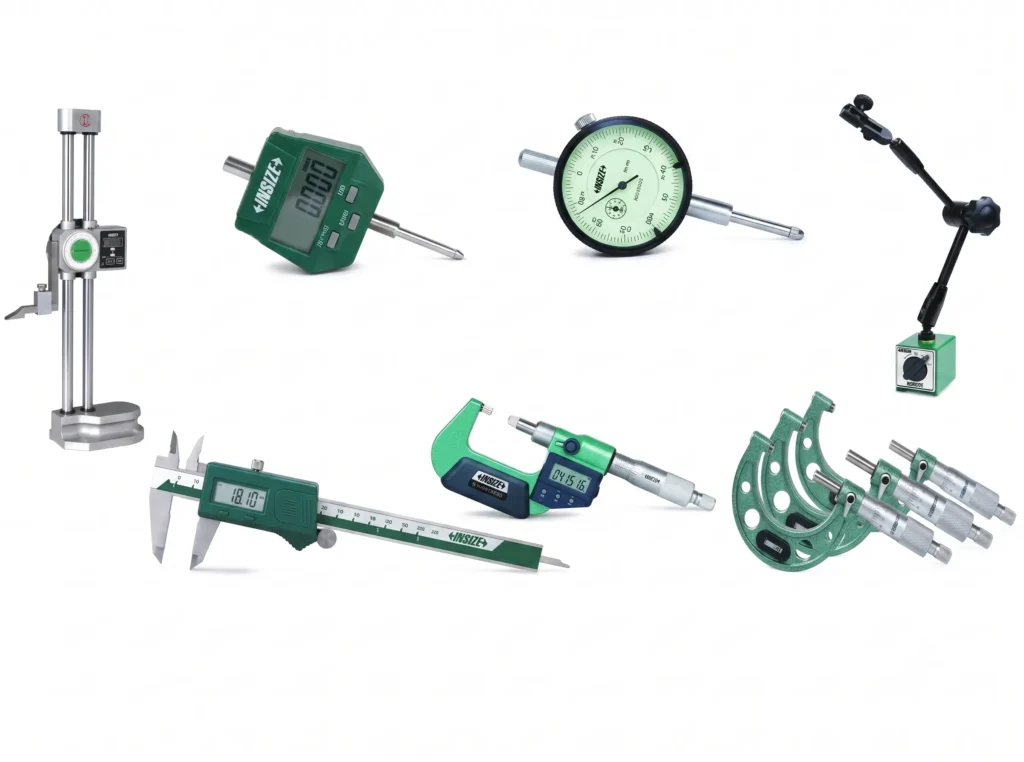
KTRDG’s precision measuring instruments range includes products from Insize and Mitutoyo — two of the best-known brands in dimensional metrology.


With more than 35 years of industrial tool supply experience, Khokhawala Trading LLC serves manufacturers, CNC shops, fabrication companies, and engineering industries in the UAE. If you already know which caliper type and range you need, you can browse the KTRDG shop directly. For an application-specific recommendation, contact Khokhawala Trading LLC with the material, the required range, and the working environment.
Ready to shop precision measuring instruments? Browse our Insize and Mitutoyo caliper range or reach out with your requirement for a fast quote.
A Simple Caliper Selection Checklist
Before choosing a digital or vernier caliper, confirm these points:
- What is the required measuring range?
- What resolution and accuracy does the job require?
- Will the caliper be used in a wet, coolant-heavy, or dusty environment?
- Do operators need to switch between inch and metric regularly?
- Is data logging or SPC output required?
- Will the workpiece include very hard or abrasive materials?
- Is a battery-free backup tool needed alongside a digital model?
- Who will be using the tool, and how experienced are they with vernier reading?
Answering these questions first makes it far easier to choose a caliper that fits the actual job, rather than simply the most familiar type.
Conclusion
Digital and vernier calipers measure the same dimensions in the same basic way — the real difference is in how the reading is taken, how the tool behaves in your specific working environment, and how it fits your budget.
A digital caliper offers a direct readout, unit switching, and — on ABSOLUTE-type models — no need to reset zero, with some models sealed against dust and coolant. A vernier caliper offers a fully mechanical, battery-free design that remains reliable as a backup or primary tool once an operator is comfortable reading it.
For businesses sourcing precision measuring instruments in Dubai, Khokhawala Trading LLC supplies Insize and Mitutoyo calipers and related inspection tools for manufacturing, engineering, and quality control applications.
Need Help Choosing the Right Caliper?
Visit the KTRDG shop or contact Khokhawala Trading LLC with your required range, resolution, and working environment.
Digital vs Vernier Calipers, Answered
Both measure the same dimensions using the same jaws and beam. The difference is in the readout: a vernier caliper is read from a mechanical scale, while a digital caliper displays the measurement on an electronic LCD screen.
Accuracy depends on the specific instrument and its manufacturing tolerance, not simply on whether it is digital or vernier. A well-made vernier caliper, used with correct technique, can be just as accurate as a comparable digital model of similar range.
Standard digital calipers in the 150-200 mm range are commonly specified with a resolution of 0.01 mm (.0005 in) and an accuracy of around ±0.02 mm (±.001 in).
You find where a line on the sliding vernier scale lines up exactly with a line on the fixed main scale. On a typical metric caliper, each vernier division represents 0.02 mm, giving a resolution of 0.02 mm without any mechanical magnification.
Yes. Digital calipers are electronic instruments and are commonly powered by a small button cell battery such as an SR44. Vernier calipers are fully mechanical and need no battery.
Some digital calipers are built with IP ratings such as IP66 or IP67, giving protection against dust and against low- or high-pressure liquid jets, or short-term immersion. Always check the specific model’s IP rating before using it in these conditions.
A vernier caliper’s scale is a fixed, physically engraved mechanical scale in either inch or metric graduations, so it cannot convert seamlessly between the two units. Digital calipers convert electronically and many can switch at the press of a button.
It’s a digital caliper technology that reads the slider’s absolute position at any point and at any time, even after the caliper has been switched off, removing the need to re-zero the tool at every power-on the way conventional digital calipers require.
It’s good practice to close the jaws and confirm a zero reading before starting a batch of measurements, spending no more than a few seconds on the check — even on ABSOLUTE-type digital calipers that don’t strictly require it.
Khokhawala Trading LLC supplies precision measuring instruments, including calipers, in Dubai and across the UAE. KTRDG’s precision measuring instruments range includes products from Insize and Mitutoyo.