
What’s the Difference Between HSS and Carbide Cutting Tools?

Walk into any machine shop and you’ll find both HSS and carbide tools sitting in the same drawer, and there’s a reason for that — neither one replaces the other. Each has a specific combination of hardness, toughness, and heat resistance that makes it the better choice for a given job.
This guide explains what HSS and carbide actually are, why carbide can cut roughly four times faster than HSS, and why HSS still accounts for a real share of the tools used in machine shops today rather than having been fully replaced.
Not sure whether your job needs HSS or carbide? Tell our team the material and operation, and we’ll help you choose the right tool.
What Is HSS (High-Speed Steel)?
High-speed steel is a subset of tool steels, alloyed with elements such as tungsten, molybdenum, chromium, vanadium, and sometimes cobalt. Compared to high-carbon steel tools, HSS can withstand higher temperatures without losing its temper (hardness), which allows faster cutting speeds. At room temperature, standard HSS grades display high hardness — above 60 Rockwell C — combined with good abrasion resistance.
The two most widely used families are tungsten-type grades (such as T1) and molybdenum-type grades (such as M2). M2 is the most widely used industrial HSS grade: it has small, evenly distributed carbides that give high wear resistance, a bending strength that can reach 4,700 MPa, and toughness around 50% higher than T1. It’s commonly used to manufacture drill bits, taps, and reamers.
Adding cobalt increases heat resistance and can push hardness up to 70 Rockwell C. M35 (also called HSS-E or Cobalt Steel) adds 5% cobalt to the M2 composition and cuts faster and lasts longer as a result. M42 adds 8% cobalt and is widely used in metal manufacturing for its superior red-hardness — its ability to hold hardness at high temperature — which allows shorter cycle times through higher cutting speeds or longer intervals between tool changes.
Despite decades of carbide development, HSS still accounts for around 20% of the global cutting tool materials market, largely because of its significant toughness and resistance to cracking compared with cemented carbide.
What Is Carbide (Cemented Carbide)?
Cemented carbide is a powder metallurgical material — a composite of tungsten carbide (WC) particles held together by a binder rich in metallic cobalt. Cemented carbides used for metal cutting typically consist of more than 80% hard-phase tungsten carbide. The WC grain size is one of the most important parameters for adjusting the hardness-to-toughness relationship of a given grade: a finer grain size means higher hardness at a given binder content.
Cemented carbide was patented in 1923 by Karl Schröter, then head of R&D at Osram, originally intended for drawing dies in the light bulb industry. It was later developed and tested as a cutting tool material and introduced at an exhibition in Leipzig in 1927. Its arrival allowed for steel cutting speeds of up to 150 metres per minute — close to four times faster than high-speed steel.
Today, coated cemented carbide represents around 80-90% of all cutting tool inserts, owing to its unique combination of wear resistance and toughness and its ability to be formed into complex shapes. Coatings applied via CVD (chemical vapor deposition, generated by chemical reactions at 700-1,050°C) or PVD (physical vapor deposition) further tailor a grade’s wear resistance, heat resistance, and edge toughness for specific applications — CVD coatings are typically used on turning, milling, and threading inserts, while PVD-coated grades are extensively used for finishing operations and for drilling.
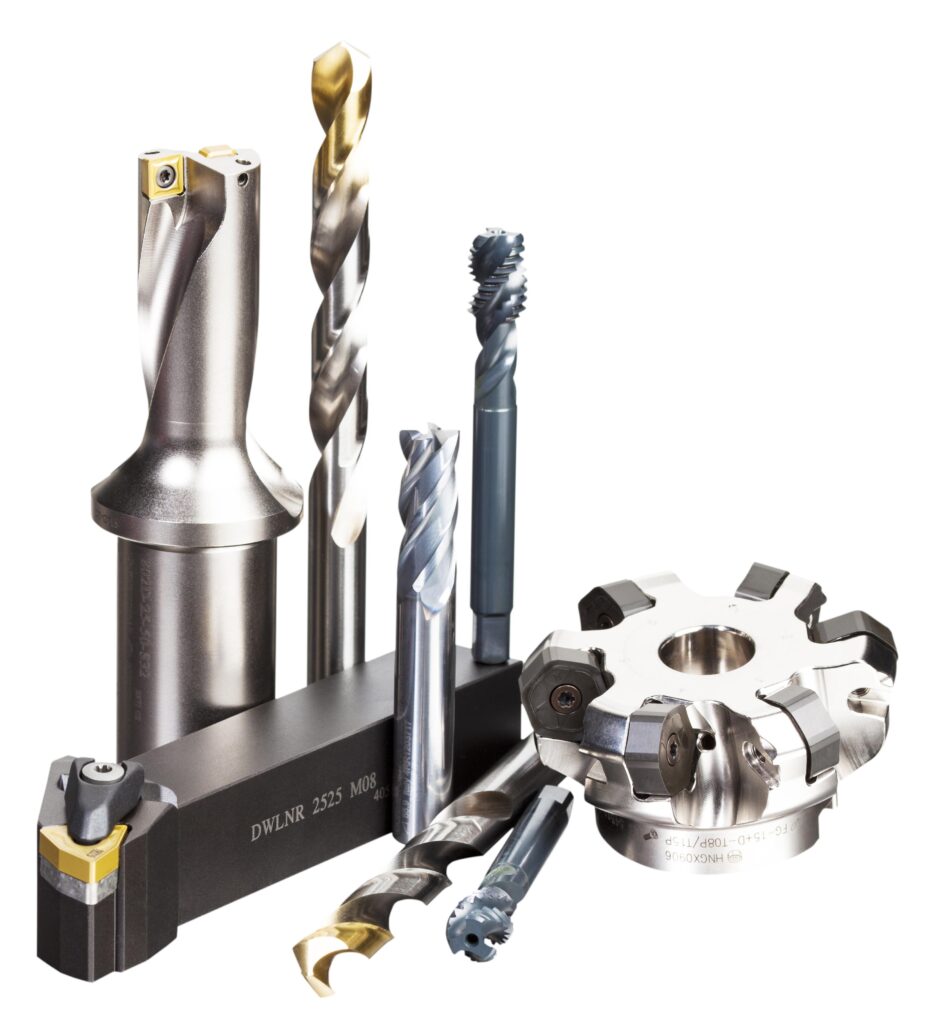
HSS vs Carbide: At a Glance
| Factor | HSS | Carbide |
|---|---|---|
| Composition | Tool steel alloyed with tungsten and/or molybdenum, chromium, vanadium, sometimes cobalt | Tungsten carbide particles (>80%) cemented with a cobalt-rich metal binder |
| Hardness at room temperature | Above 60 HRC (standard); up to 70 HRC with cobalt-added grades | Higher than HSS; finer WC grain size increases hardness further |
| Achievable cutting speed | Baseline (the original benchmark that gave HSS its name) | Up to roughly 4x faster than HSS — up to 150 m/min in steel |
| Toughness / crack resistance | Significant toughness and resistance to cracking; better bending strength and fracture toughness than carbide | Lower toughness than HSS at a given hardness, though modern grades balance the two via grain size and binder content |
| Cost | Less expensive | More expensive, but often more cost-effective per part at higher production volumes due to speed |
| Current global market share (all cutting tool materials) | ~20% | ~53% (with ceramic, PcBN, and PCD making up most of the remainder) |
| Typical tools | Drill bits, taps, reamers, milling cutters, hobbing cutters, saw blades, hand tool blades | Turning inserts, milling inserts, solid carbide end mills and drills, threading and grooving tools |
Need genuine HSS or carbide tooling for a specific job? Send us the material and operation and we’ll match you with the right tool.
Why Carbide Cuts Faster Than HSS
Both materials owe their existence to the same underlying problem: ordinary carbon steel tools lose their cutting edge once the friction of cutting pushes the tool above roughly 210°C. High-speed steel was developed specifically to withstand much higher temperatures without softening, which is what let cutting speeds roughly double or triple over the carbon steel tools that came before it.
Cemented carbide pushed that same principle further. Its tungsten carbide hard phase gives it both higher hardness and higher thermal conductivity than HSS, letting it maintain a cutting edge at temperatures HSS can’t tolerate — which is exactly why cemented carbide tools can run at up to roughly four times the cutting speed of HSS in steel.
Why HSS Still Has a Place in the Shop
If carbide cuts faster, why does HSS still hold roughly a fifth of the global cutting tool market? The answer is toughness. HSS has significant resistance to cracking and better bending strength and fracture toughness than cemented carbide, which matters most in interrupted cuts, thin or fragile tool geometries, and lower-rigidity setups where a brittle edge would chip or fracture before it ever wore out.
HSS is also less expensive than cemented carbide, and it can be resharpened repeatedly rather than indexed or discarded — a genuine advantage for tools like drills, taps, and reamers that see long service life in general-purpose or lower-volume work. High speed steel tools remain the most popular choice for woodturning as well, since HSS holds its edge far longer than high-carbon steel and suits the relatively high speed of handheld tool movement against the work.
Choosing Between HSS and Carbide for Your Job
Production Volume and Cutting Speed
For high-volume production where cycle time drives cost, carbide’s roughly 4x speed advantage over HSS usually outweighs its higher upfront price per tool.
Machine Rigidity and Setup
Carbide’s lower toughness makes it more sensitive to vibration, chatter, and interrupted cuts. On older, less rigid machines, or in setups where vibration can’t be fully controlled, HSS’s greater resistance to cracking can mean fewer broken tools.
Tool Geometry Complexity
Thin, delicate, or highly complex tool profiles that would be prone to chipping in a harder, more brittle carbide are often still made in HSS, where the extra toughness protects fine detail in the cutting edge.
Budget and Batch Size
For one-off jobs, prototyping, or lower-volume work, HSS’s lower cost and resharpenability often make more economic sense than committing to carbide inserts.
Heat-Sensitive or High-Temperature-Generating Materials
Where sustained high-temperature cutting is unavoidable, carbide’s superior heat resistance and hardness retention make it the more reliable choice, since HSS’s advantage over ordinary carbon steel is temperature tolerance — but carbide extends that tolerance considerably further.
Common Mistakes When Choosing Between HSS and Carbide
Assuming Carbide Is Always the “Better” Choice
Carbide is faster, not universally better. On an interrupted cut or a less rigid setup, HSS’s toughness can outperform carbide’s speed advantage by simply not breaking.
Running Carbide at HSS-Era Feeds and Speeds
Carbide is designed to be run considerably faster than HSS. Under-utilizing it by running conservative, HSS-appropriate cutting data wastes the tool’s main advantage.
Ignoring the Coating on a Carbide Insert
CVD- and PVD-coated carbide grades are tailored for different applications — CVD-coated grades suit turning, milling, and threading, while PVD-coated grades are common for finishing and drilling. Picking a grade without checking the coating can leave performance on the table.
Discarding HSS Tools Instead of Resharpening
Unlike indexable carbide inserts, HSS tools can typically be resharpened multiple times, which is often the more economical choice for general-purpose drills, taps, and reamers.
Sourcing HSS and Carbide Cutting Tools in Dubai
Khokhawala Trading LLC supplies both HSS cutting tools and premium carbide tooling systems for CNC machining, metal cutting, milling, turning, and drilling in Dubai and across the UAE.
KTRDG’s carbide tooling range includes products from Sandvik Coromant, Kennametal, Korloy, and Mitsubishi.



With more than 35 years of industrial tool supply experience, Khokhawala Trading LLC serves manufacturers, CNC shops, fabrication companies, and engineering industries across the UAE.
Ready to shop cutting tools? Browse our HSS cutting tools and carbide tooling systems range or reach out with your requirement for a fast quote.
A Quick HSS vs Carbide Checklist
- Is this a high-volume job where cycle time drives cost, or a low-volume/one-off job?
- Is the setup rigid, or is vibration and chatter likely (interrupted cuts, older machines)?
- Does the tool geometry include thin, delicate, or highly complex profiles?
- Will sustained high temperature at the cutting edge be a factor?
- Is budget for tooling per job a bigger constraint than cycle time?
- If carbide, does the grade’s CVD or PVD coating actually match the operation (turning/milling/threading vs. finishing/drilling)?
- If HSS, is resharpening a realistic option for this tool type, rather than one-time use?
Conclusion
HSS and carbide solve the same underlying problem — keeping a cutting edge hard enough to hold up under the heat of machining — at two different points on the speed-versus-toughness spectrum. Carbide cuts roughly four times faster and dominates today’s market at around 53% of cutting tool materials, but HSS still holds around 20% of that market on the strength of its toughness, lower cost, resharpenability, and resistance to cracking in interrupted or less rigid cuts.
For businesses sourcing cutting tools in Dubai, Khokhawala Trading LLC supplies both HSS cutting tools and Sandvik Coromant, Kennametal, Korloy, and Mitsubishi carbide tooling for CNC machining, milling, turning, and drilling applications.
Not Sure Which Tool Material Fits Your Job?
Send us your material and operation, and Khokhawala Trading LLC will help you choose between HSS and carbide.
HSS vs Carbide, Answered
High-speed steel is a tool steel alloyed with tungsten and/or molybdenum, along with chromium and vanadium, and sometimes cobalt. Standard HSS grades reach a hardness above 60 Rockwell C.
Cemented carbide is a powder metallurgical composite of tungsten carbide (WC) particles cemented together with a metal binder rich in cobalt. Cemented carbides used for metal cutting typically consist of more than 80% hard-phase tungsten carbide.
Carbide. It enabled steel cutting speeds of up to 150 metres per minute, close to four times faster than high-speed steel, due to its higher hardness and thermal conductivity.
Yes. HSS has significant toughness and resistance to cracking compared with cemented carbide, along with better bending strength and fracture toughness, which is why it’s still preferred for interrupted cuts and less rigid setups.
HSS still accounts for around 20% of the global cutting tool materials market. It’s less expensive than carbide, can be resharpened rather than discarded, and its greater toughness handles interrupted cuts and thin tool geometries that a more brittle carbide edge could chip.
HSS-E, also called M35 or Cobalt Steel, adds 5% cobalt to the standard M2 HSS composition. The added cobalt improves heat resistance, letting it cut faster and last longer than standard M2.
Yes. Unlike indexable carbide inserts, which are typically discarded or professionally reconditioned, HSS tools such as drills and reamers can generally be resharpened multiple times, which is often more economical for general-purpose, lower-volume work.
CVD (chemical vapor deposition) coatings are generated by chemical reactions at 700-1,050°C and offer high wear resistance with excellent adhesion to carbide; they’re commonly used for turning, milling, and threading. PVD-coated grades are widely used for finishing applications and drilling.
HSS is often the more economical choice for one-off or low-volume jobs, since it’s less expensive than carbide and can be resharpened rather than replaced, and the job likely won’t run long enough to benefit fully from carbide’s speed advantage.
Khokhawala Trading LLC supplies HSS cutting tools and carbide tooling systems, including Sandvik Coromant, Kennametal, Korloy, and Mitsubishi products, in Dubai and across the UAE.